DESIGN
eyebrow
Poetry in the Process
text-h1
A Netherlands-based artisan crafts astonishing new designs from disused material.
STORY BY RACHEL ARROYO
STORY BY RACHEL ARROYO
Plastic is the ubiquitous waste of modern life—a material we reach for instinctively and discard without a thought. Yet in a converted 1920s warehouse in Eindhoven, the Netherlands, designer Dirk van der Kooij has spent almost two decades repurposing plastic into furniture of such weight and sophistication that it now lives in the permanent collections of MoMA, the Centre Pompidou, the Stedelijk Museum Amsterdam, and the Design Museum in London. These are functional works of art designed to last for generations.
.avif?assetname=Poetry+in+Process+%281%29.png&originalImageWidth=700&originalImageHeight=817)
.avif?assetname=Poetry+in+Process+%282%29.png&originalImageWidth=700&originalImageHeight=817)
PHOTOS BY STUDIO KOOIJ
In all his work, van der Kooij adheres to three tenets: longevity, functionality, and joy.
false
false
false
false
Trained as a carpenter in Amsterdam before studying at the renowned Design Academy Eindhoven, van der Kooij knew early that mass-produced furniture had no place in the work he wanted to make. Instead, he turned to something far less obvious: discarded plastic. Six pizza ovens welded together became his first act of alchemy, heating and cooling the material outside a mold until it wrinkled into vivid organic form. The Elephant Skin series was born: the ultimate imitator, as the studio puts it, finally finding its own identity.
Today, his team of carpenters, welders, colorists, and finishers works in close step with house-developed robots, 3D printers, presses, and extruders. Each applies their own craft to over 30 tonnes of discarded material annually—including CDs, leather sofas, diseased wood—transforming what was once thrown away into furniture that is unique, unexpected, and built to last. The Meltingpot tables, pressed from studio offcuts into layered slabs of color, are perhaps the purest expression of this: heirloom objects carrying the literal history of their own making.
For van der Kooij, the process is never hidden; it is the point. The Living Kitchen magazine recently connected with him to talk about his work.
.avif?assetname=Poetry+in+Process+%283%29.png&originalImageWidth=700&originalImageHeight=817)
.avif?assetname=Poetry+in+Process+%284%29.png&originalImageWidth=700&originalImageHeight=817)
PHOTOS BY STUDIO KOOIJ
LEFT: Made from extruded recycled plastic, the sloping Wandel bowl is available in a range of color schemes depending on the material’s past life. RIGHT: The Buitenhuis chandelier is a segmented halo composed of twinkling, 3D-printed arcs.
false
false
false
false
The Living Kitchen: What drew you to plastic as a medium?
Dirk van der Kooij: The poetry lies in developing a process and a design that elevate the worthless into the most desirable. It was not plastic itself that drew me, but rather the recycled aspect, the ability to give a material more value than it ever had before. We developed processes to transform this man-made material from something disposable into something heavy, solid, and unbreakable—‘multiple-generation design pieces.’
TLK: You’ve built presses, robots, and extruders to help you shape plastic, and later other repurposed materials, to create sculptural forms. How do you think about authorship—where does your design intention end and the machine’s behavior begin?
D.v.d.K.: At heart, I am a true maker—someone who loves creating jigs and molds to make the actual handwork better and more precise. I have always seen these newly developed processes as digital molds or jigs. The process I developed was not 3D printing in the common sense—a method to create anything—but rather a way to create solid, heavy pieces with a distinct growing pattern that acts as an ornament, showing a direct relationship to the making of the objects.
Conceptually, these thick ribbons in my pieces are like the rings of wood. Because of this super-low-resolution process, it is a very limited technique. In the end, the process is more an artistic language than something generative; it is where the puzzle begins—to create something that feels natural and not limited by the process.
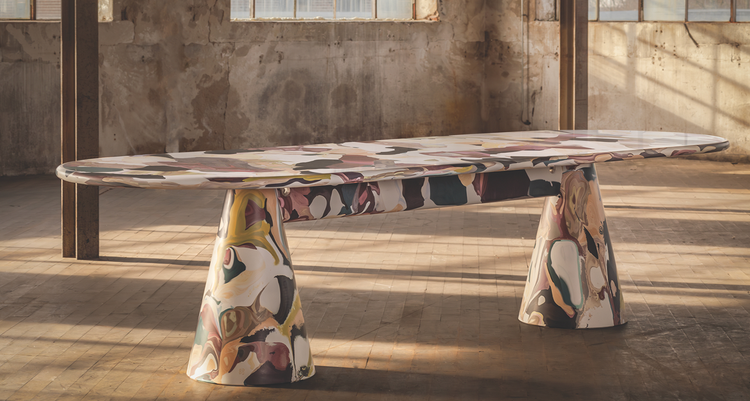
PHOTO BY STUDIO KOOIJ
Meltingpot tables offer a third incarnation of recycled plastic, as each uses prototypes and color tests from the Kooij studio.
.avif?assetname=Poetry+in+Process+%285%29.png&originalImageWidth=700&originalImageHeight=817)
.avif?assetname=Poetry+in+Process+%286%29.png&originalImageWidth=700&originalImageHeight=817)
PHOTOS BY STUDIO KOOIJ
false
false
false
false
TLK: Does your work speak more to sustainability or to how material history shapes identity?
D.v.d.K.: We start with reclaimed synthetics. As all our processes are experimental and driven by artistic output, the failure rate is high. That is why we developed the Meltingpot series—a conceptual way of reusing that allows us to use larger parts of mismade chairs and offcuts, so that the origin of the input always remains visible.
In the tables, there are sometimes chunks of material from years ago; we build up a kind of strata of all the colors and patterns used over time. In this way, we give identity to a mass that did not have it before. Our colorist investigates each chunk of material that goes into the composition, carefully placing it in the pressing mold, imagining what it will become after it has been pressed and cut. The result is painterly, but more like composing from fragments of studio history.
TLK: What do you hope the viewer takes away from their interaction with your work?
D.v.d.K.: That you feel the work is an ode to the materials used. I am always thrilled when a piece is perfectly made, using solid and heavy-duty materials in the right way. And then, knowing that you can feel less guilty about using such an amount of material because it has been reused—I love that.
eyebrow
text-h1
PUBLISHED JULY 2026
Similar Stories
text-h2
DESIGN
eyebrow
Natural Resources
text-h3
Southern California’s Morrison Interiors lets the landscape lead the way in a stunning hillside home.
.avif?assetname=Poetry+in+Process+%287%29.png&originalImageWidth=458&originalImageHeight=287)
third
DESIGN
eyebrow
Living Boldly
text-h3
Color and character fill a Texas ranch house designed by Houston-based Creative Tonic.
.avif?assetname=Poetry+in+Process+%288%29.png&originalImageWidth=457&originalImageHeight=286)
third
DESIGN
eyebrow
Designed with Purpose
text-h3
A vibrant pantry and bold dining room showcase the possibilities of Sub-Zero, Wolf, and Cove.
.avif?assetname=Poetry+in+Process+%289%29.png&originalImageWidth=458&originalImageHeight=287)
third